
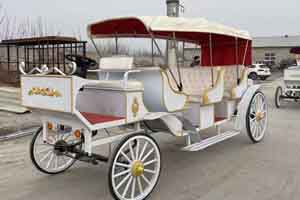
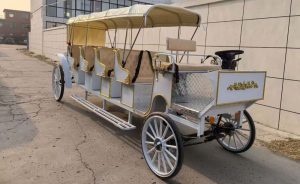
Regulations on Driver’s Licenses for Electric horseless carriage (Electric Sightseeing Carriages)
Key distinctions include: electric vs. non-electric drive; private vs. commercial use; speed and power output; and differing regulations between the EU and the US/Canada. These fall into two main categories: purely human-powered/unpowered carriages and electric motor-driven carriages.
I. Purely Unpowered Carriages (No motor; human-powered or coasting)
1. United Kingdom
Private use for personal transport: No motor vehicle driver’s license required; not subject to motor vehicle regulations; compliance with general traffic rules suffices (e.g., Prince Philip could drive a horse-drawn carriage without a car license).
Commercial sightseeing/passenger transport: Must obtain a local municipal “Hackney Carriage Licence.” Most cities require the driver to hold a valid standard car license, pass a medical exam, and complete a road test; vehicles require annual inspections and third-party liability insurance.
2. United States (Federal & State levels)
Private use: No motor vehicle driver’s license required nationwide; unpowered carriages are not classified as motor vehicles. Requirements are limited to compliant lights and reflectors, and meeting a minimum driving age (typically 12–16 years old).
Commercial use in tourist areas: Major tourist cities nationwide (e.g., New York, Charleston) mandate operating permits; some cities require drivers to hold a Class C license and require vehicle registration/licensing.
3. Canada & Australia
Private use on public roads requires no license. Commercial operation in tourist areas requires a municipal sightseeing operating license; while there is no specific “carriage driver’s license,” drivers are generally required to hold a valid standard passenger car license.
4. Continental Europe (France, Germany, Italy, Spain)
Human-powered/unpowered carriages: No license required for private use on public roads. Commercial sightseeing requires a passenger transport permit; many locations (e.g., Rome, Barcelona) have restricted sightseeing carriages in city centers, limiting access to parks only.
II. Electric Horseless Carriages(Motor-driven; mainstream sightseeing models)
The EU enforces unified regulations for L-category motor vehicle classification, determining license requirements based on power output, top speed, and curb weight:
Low-speed models: Top speed ≤45 km/h, motor power ≤6 kW, vehicle weight <425 kg (L6e light four-wheeled vehicle).
EU (Germany/France/Italy/Netherlands): Requires an AM moped license (eligible at age 14); a standard C1 passenger car license is insufficient. Vehicle registration and mandatory liability insurance are both required.
UK equivalent: Classified as a light four-wheeled vehicle; can be driven at age 16 with an AM license or at age 17 with a provisional car license.
High-speed/high-power models: Top speed >45 km/h, motor power >6 kW.
Unified across Europe and the US: Classified as standard motor vehicles; requires a Class B (C1) passenger car license; subject to the same registration and annual inspection requirements as private sedans.
US Electric “Horseless Carriages”
No unified federal regulations; rules vary by state:
Low-speed electric (≤32 km/h): Most states classify these as low-speed vehicles (LSVs); no car license required, though commercial operation in some tourist areas requires an operating permit.
High-power electric (>32 km/h): Classified as standard motor vehicles; requires a passenger car license plus vehicle registration and licensing.
III. Summary (Practical for export/sightseeing operations)
Personal recreational use (non-motorized/no motor): No license required in the vast majority of European and American countries.
Commercial passenger transport in tourist areas (motorized or non-motorized): Operating permits are mandatory in almost all tourist cities worldwide; most require the driver to hold a passenger car license.
Electric horseless carriages (mainstream sightseeing models): EU standard requires an AM license (B license for high-power models); US requirements depend on top speed (car license needed if exceeding 32 km/h).
If you would like to learn more about horseless carriages, please contact Guangsh.