
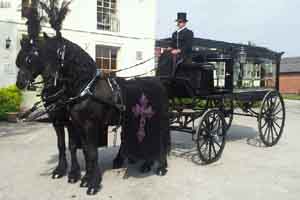
Horse drawn hearse can be classified into eight categories based on appearance, structure, purpose, and region.
Horse drawn hearses originated in the Victorian era and encompass eight major categories, including enclosed civilian carriages for viewing the casket, open military gun-carriage hearses, minimalist vintage-style carriages, luxurious royal court-style hearses, and ceremonial carriages with distinctive color schemes.
1. Glass Coach (top-tier standard model)
Exterior and Structure
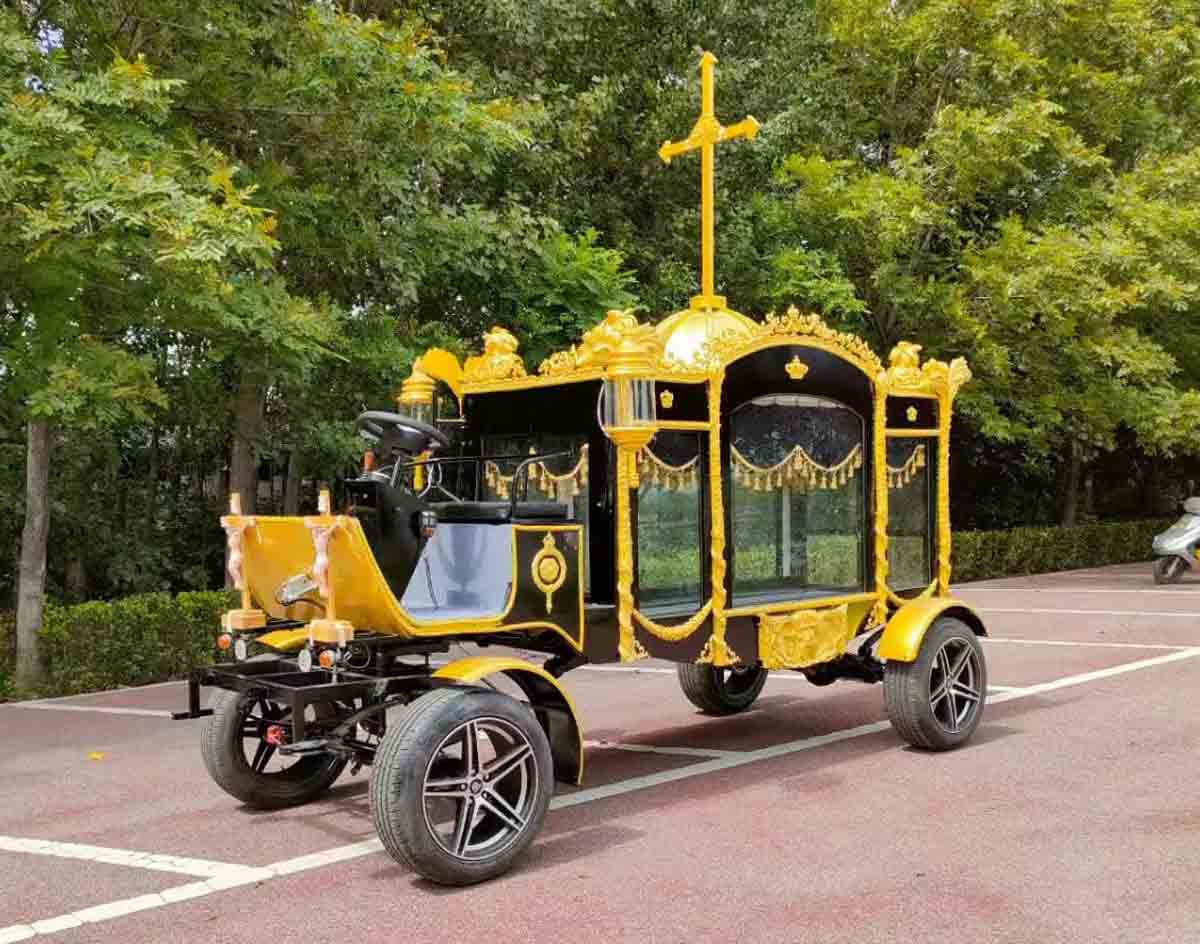
Solid wood carved frame with an overall matte black finish, featuring extensive gilded relief ornamentation (motifs include olive branches, fleurs-de-lis, angels, and scrolling floral patterns); the carriage body features seamless, curved, full-height tempered glass panels on all four sides, offering an unobstructed view of the casket for onlookers.
Tiered, soaring dome roof with upright brass candelabras at the four corners (designed to hold lit white candles during ceremonies); the base is equipped with a silent steel sliding track system for smooth casket loading, while the interior is lined with burgundy velvet cushioning and features a concealed floral mounting bracket.
Four solid wood spoked wheels with shock-absorbing suspension; a separate, elevated driver’s seat at the front, with the option to add a small auxiliary seat for an attendant.
Traction and Classification
Two-horse team: Suitable for wealthy individuals and urban church funerals;
Four-horse team: Suitable for royalty, celebrities, and grand memorial ceremonies; draft horses are uniformly jet-black, adorned with black velvet harnesses, plume headpieces, and draped black veils.
Regional Suitability
Ideal for high-end vintage-style funerals in the UK, USA, Australia, and Continental Europe; this is the most globally recognized horse drawn hearse model.
2. Landau-style Horse drawn Hearse (Wide-body, high-capacity)
Key Features
Derived from the aristocratic Landau carriage, it features a retractable rear soft-top that can be closed during rain or opened in fair weather to display the casket. The body is widened and lengthened, offering significantly more interior space than Victorian-style models; it accommodates large caskets and abundant floral tributes, and can even fit double caskets for joint burials.
It features segmented side windows with minimalist frames and restrained ornamentation, avoiding the elaborate gilding found on “Palace-style” models; the body lines are smooth, ensuring a stable ride.
Dual sliding side doors facilitate easy access for pallbearers.
Usage Scenarios
Large-scale American country-style funerals, collective church memorial services, and outdoor lawn farewell ceremonies; it also serves as a primary base for white-horse-drawn white hearses (featuring an all-white body and white horses, often used for gentle Christian memorial services).
3. Victoria Hearse (standard for small and medium-sized cities)
Exterior Features
The vehicle features a low, compact profile, narrow single-row windows, and a simple single-layer roof; its overall small size and agility make it ideal for navigating the narrow streets of historic European cities and small-town lanes.
It is equipped with a retractable soft-top canopy and features a minimalist aesthetic with only subtle brass trim accents; due to its lower production cost, it is a staple for small-to-medium-sized funeral homes.
Designed for a two-horse team only; it cannot accommodate a four-horse formation. The interior is fitted with basic guide rails but lacks elaborate floral mounting brackets.
Positioning
Suitable for accessible vintage-style ceremonies and small-to-medium family funerals; it is the standard entry-level horse-drawn hearse found in British villages and small American towns. The S-shaped “Landau bar” trim found on the sides of modern motor hearses originated from the roof support mechanism of this specific carriage model
4. Brougham Hearse (Fully Enclosed, Private Style)
Unique Design
Features a nearly fully enclosed cabin with only a small, narrow window at the front; the sides and rear are completely sealed and fitted with heavy black velvet curtains that fully conceal the casket throughout the journey. It emphasizes solemnity and privacy, ensuring the deceased remains unseen by the public.
The vehicle is compact enough to be drawn by a single horse and was the standard choice for short-distance urban funeral transport in the 19th century. It features a flat roof without protrusions or superfluous ornamentation, projecting a somber, understated aesthetic.
Target Audience
Suited for traditional, conservative families who prefer discretion and wish to avoid public onlookers. It has largely fallen out of general use and is now primarily found in vintage museums or used for historical reenactments.
5. Military Caisson/Gun Horse drawn hearse (Reserved for state funerals and military personnel)
Comprising two main types—the U.S. Army caisson and the Royal Navy gun carriage—these vehicles feature no enclosed cabin, consisting instead of a completely open flatbed; they are distinct from civilian horse-drawn hearses.
1. U.S. Army Caisson Hearse (Standard at Arlington National Cemetery)
Features a heavy-duty steel military chassis and a matte-black metal flatbed equipped with low side rails and securing straps, designed specifically to carry a flag-draped military casket; utilizes oversized solid-wood spoked military wheels capable of bearing heavy loads.
Drawn by a team of four black draft horses, with eight ceremonial infantrymen walking alongside to steady the casket throughout the procession; reserved exclusively for fallen service members, retired generals, and U.S. Presidents (used for the burials of Ronald Reagan and John F. Kennedy).
2. Royal Navy Gun Carriage (State Funeral Gun Carriage)
A modified vintage artillery carriage weighing 2.5 tons, reserved for royal state funerals (used for Queen Victoria, Winston Churchill, and Queen Elizabeth II); traditionally not horse-drawn, but instead pulled by Royal Navy sailors—a unique British ceremonial protocol.
6. Imperial State Hearse (Exclusive to the Austro-Hungarian and European royal families)
Luxurious Specifications
Hand-carved from solid wood, featuring extensive gilded relief work, crowns, and royal coats of arms; the design includes a domed roof with multi-tiered eaves and angel sculptures at the four corners. Weighing between 3 and 4 tons, it requires a team of 6–8 large draft horses to pull.
Features gold-rimmed glass and an interior fully lined with velvet and silk; accompanied by exclusive royal black harness sets. Historically reserved for the funerals of royalty and the highest nobility; currently housed in the Vienna Carriage Museum, it is brought out only for major commemorative ceremonies.
Notable Use: The funeral carriage for Empress Elisabeth (“Sisi”) and the last monarch of the Austro-Hungarian Empire.
7. Specialized Color Variants (Categorized by body color)
All-Black Horse-Drawn Hearse: The global standard (black body + black draft horses); suitable for the vast majority of traditional funerals, symbolizing mourning and solemnity.
All-White Horse-Drawn Hearse: White body + white draft horses; interior features off-white satin. Often used for Christian or Catholic memorial services, children’s funerals, and minimalist ceremonies; has gained popularity in Europe and the US in recent years.
Matte Dark Gray / Navy Blue Hearse: Nordic minimalist style; lacks gilded carvings and features simple lines, reflecting local values of low-carbon living and simplicity regarding life and death.
8. Niche Vintage/Simplified Horse Drawn Hearse
Skeleton Break (Open-frame hearse)
Lacks a fully enclosed cabin, consisting only of a metal frame and platform; the coffin is displayed completely in the open, accented with minimal black veiling. Used for distinctive funerals for farmers, motorcycle enthusiasts, or outdoor professionals.
Vintage Two-Wheeled, Single-Horse Hearse
An early 19th-century style featuring a single axle and drawn by one horse; very compact in size. Used primarily for short-distance coffin transport within estate grounds and rarely seen in modern street processions.