
Can horse drawn carriages travel on modern roads?Regulations regarding this issue vary by country; here, I will briefly outline some of the controls and measures in place.
In China, under the Road Traffic Safety Law, horse-drawn carriages are classified as non-motorized vehicles; they may legally travel on ordinary suburban and rural roads but are strictly prohibited from expressways, urban express routes, and most major thoroughfares in city centers.
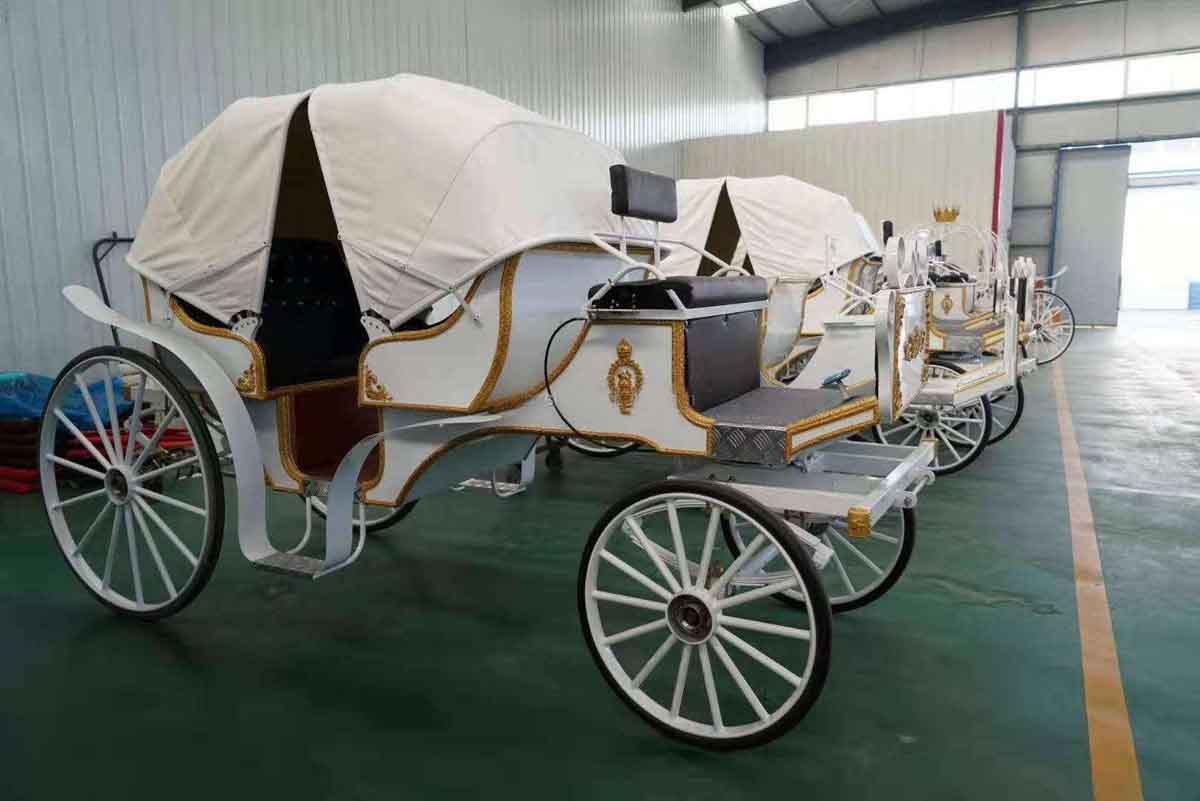
I. Legal Classification: Hors drawn carriages are classified as animal-drawn non-motorized vehicles; they are permitted on the road but subject to strict restrictions.
1. Areas where hors drawn carriages are strictly prohibited:
Expressways, urban elevated roads, rapid transit roads, and tunnels (regulations explicitly prohibit non-motorized vehicles from entering these areas);
Central urban areas of major cities and core tourist/commercial districts: Local traffic authorities often ban animal-drawn vehicles from entering the city center; violations result in orders to leave and fines.
2. Rules for permitted roads (ordinary roads in townships and suburbs):
Drivers must be at least 16 years old and sober; horses must be docile and controllable (spirited or wild horses are prohibited);
Travel must occur in non-motorized vehicle lanes; where dedicated lanes are absent, the carriage must stay close to the far-right edge of the road—blocking traffic or driving side-by-side is prohibited;
At intersections, curves, steep slopes, and narrow bridges, the driver must dismount and lead the horse; overtaking is prohibited;
At night, reflective markers and warning tail lights must be installed, and the carriage must be equipped with a braking system;
Overloading (passengers or cargo) is prohibited; when parked, the brake must be engaged and the horse securely tethered to prevent accidents caused by the horse being startled.
II. Additional controls for commercial sightseeing carriages (scenic areas / wedding carriages)
Commercial horse carriages operated in scenic areas or for weddings may only travel on enclosed roads within the scenic area or on specifically designated sightseeing routes; they are not permitted to enter public urban arterial roads at will. Operators must file reports, purchase insurance, and undergo regular inspections of both the carriage and the horse.
III. General rules abroad (Europe and North America)
In countries such as the US, UK, and Australia, horse-drawn carriages are generally permitted on rural roads:
They must display reflective warning signs for slow-moving vehicles and be equipped with front and rear lights for night travel;
Entry onto expressways and urban arterial roads is prohibited; they must travel along the edge of the road;
Commercial passenger carriages require an operating permit; private carriages do not require mandatory licensing but must comply with traffic regulations.
In summary, horse drawn carriages are permitted on ordinary roads in rural and suburban areas under compliant conditions; however, they are prohibited on highways, urban expressways, and city center roads. When traveling on these roads, all non-motorized vehicle safety regulations must be followed. Commercial horse-drawn carriages in urban areas are only permitted to use on closed sightseeing sections.
However, the question “Do you think horse drawn carriages should be banned?” has also sparked widespread public attention and controversy; the future of horse drawn carriages remains uncertain.